
The flight was almost over. A student pilot, only a few solos into his training, was turning base at Herzliya, a busy training airfield on Israel's coast. Then the radio went quiet. No tower, no other traffic, nothing.
That pilot was Allon Mason, who now builds ZuluCheck. What happened next is what this article is about. It covers the lost-comms procedures every pilot learns and few ever fly, and the light gun that controllers still keep in the tower. It looks at real events, from Cessnas to Boeing 777s, where an airplane went silent. And it sets out what the FAA, EASA, the UK, Israel, Canada and Australia actually tell you to do, plus the backup most procedures were written too early to mention: the phone in your pocket.
Key takeaways
- Radio failures are common, and usually human. NATO counted more than 900 lost-comms reports over Europe in 2018 and put more than 75% down to human error. NASA's ASRS found mis-set radios and audio panels caused over half of all interruptions to communication.
- Light aircraft lose the radio when it hurts most. ASRS reports show general aviation comms losses cluster in the approach and landing phases.
- The core procedure is the same almost everywhere. Squawk 7600, stay in visual conditions, land at the nearest suitable aerodrome, and watch the tower for light signals.
- In the US, the VFR rule is 91.129(d), not 91.185. To land at a towered airport without a radio you need VFR weather, visual contact with the tower and a clearance to land, which can come from a light gun.
- Light signals only say yes or no. A steady green in the air means cleared to land. A steady red means give way and keep circling. Flashing red means the airport is unsafe. The FAA and ICAO tables differ in small but important ways.
- Europe now names the phone. Since 1 May 2025, the EU rule SERA.14083 tells pilots to try "all available means," including mobile phones. Israel's procedures say the same, and Herzliya publishes its tower's numbers. The FAA's rules have not caught up.
- When the electrics die, the transponder dies too. Squawking 7600 then does nothing, and a phone call may be the only way to tell anyone who you are.
What "lost comms" really means
"Lost comms," "NORDO" (no radio) and, for airliners, "PLOC" (prolonged loss of communication) all describe the same situation: the pilot and air traffic control can't talk to each other. But the cause matters, because it decides what you can still do.
- The radio is fine, but you're on the wrong frequency. A digit misheard or mis-dialled on a handoff. This is the most common cause by far.
- The volume, squelch or audio panel is set wrong. You're transmitting, but you can't hear the answer.
- A stuck microphone. Your push-to-talk switch is jammed, so you're blocking the frequency for everyone. NASA's ASRS found stuck mikes caused about 60% of blocked-frequency incidents.
- The headset, jack or push-to-talk failed. Common in rental and training aircraft.
- The radio itself failed. Transmitter, receiver or both.
- The electrical system failed. The alternator quits, the battery runs down, and the radios, the transponder and often the landing gear lights go with it.
The numbers back this up. A 1993 NASA ASRS study of lost-communication reports found that mis-set radios or audio selectors caused over half of all interruptions, with radio failure next. Light single-engine pilots were more likely than others to lose comms through an actual equipment failure. The average loss lasted 7.6 minutes, and general aviation events clustered in approach and landing, exactly when the pilot is busiest.
The first 60 seconds
Before you declare the radio dead, check the things that most often turn out to be the real problem. This is a generic sequence, not taken from any aircraft's POH. Your handbook's own procedures come first.
Radio failure: troubleshooting
- 01Volume and squelchCHECK
- 02FrequencyCHECKtry the previous one
- 03Audio panelCHECKcorrect radio selected
- 04Headset plugs and push-to-talkCHECKnot stuck
- 05Second radio or second headsetTRY
- 06Avionics master and circuit breakersCHECK
- 07Transponder7600
- 08Transmit blindTWICE"transmitting blind"
- 09121.5TRY
- 10ATC by phoneCALLonly when safe
The UK CAA's 2026 radiotelephony guide for general aviation pilots uses the same idea, with an 11-item radio-failure checklist that includes making sure the push-to-talk switch isn't stuck. The CAA's Skyway Code also recommends carrying a handheld radio as a backup.
What the rules say: FAA, EASA, UK, Israel, Canada and Australia
Every country starts from the same ICAO standard. For a flight in visual conditions, ICAO Annex 2 has three steps. Keep flying in visual conditions. Land at the nearest suitable aerodrome. Then report your arrival to air traffic services "by the most expeditious means." The details differ from country to country.
United States. Two rules matter, and they're often confused:
- 14 CFR 91.185 is for IFR flights. In VFR conditions, "continue the flight under VFR and land as soon as practicable." The FAA's Aeronautical Information Manual (AIM 6-4-1) adds that "as soon as practicable" doesn't mean "as soon as possible."
- 14 CFR 91.129(d) is the VFR rule for towered airports. If your radio fails, you may land if the weather is at or above basic VFR minimums, you keep visual contact with the tower, and you receive a clearance to land. Without a radio, that clearance is a light signal.
AIM 4-2-13 spells out the arrival. If the receiver is dead, "remain outside or above the Class D surface area until the direction and flow of traffic has been determined." Then join the pattern and "watch the tower for light signals." If both transmitter and receiver are dead, "join the airport traffic pattern and maintain visual contact with the tower to receive light signals." And squawk 7600, though AIM 6-4-2 warns you "may not be in an area of radar coverage."
European Union. Commission Implementing Regulation (EU) 2024/404 rewrote the radio-failure rule, SERA.14083, from 1 May 2025. First, the pilot must try to re-establish contact "using all available means," which the rule says include data link, satellite voice and mobile phones. In the traffic pattern of a controlled aerodrome, keep a watch for visual signals. Squawk 7600, or set the ADS-B transmitter to show the loss of communication. A VFR flight shall "land at the nearest suitable aerodrome, and report its arrival by the most expeditious means." For IFR flights, the old 7-minute rule became 20 minutes.
United Kingdom. The UK kept its own procedure when the EU changed. The UK AIP (ENR 1.1, 3.4.2.3.1) says to squawk 7600 with Mode C and land at the nearest suitable aerodrome. Watch for visual signals from the ground, and report your arrival to ATC "as soon as possible." It also warns that ATC "might not be aware of the loss of communications," so watch for vehicles or traffic on the runway. The CAA's Skyway Code suggests it "may be advisable to divert to a quiet aerodrome outside of controlled airspace," then overfly, read the signal square and circuit, and land when you believe it is safe.
Israel. Israel's domestic AIP has a general procedure, ג-01, "loss of radio communication." Squawk 7600. Try the previous frequency, 121.5, other aircraft or a mobile phone, and transmit blind twice. Then continue in visual conditions and land at the nearest suitable aerodrome, using that field's own lost-comms joining procedure. Code 7600 is permanently monitored in the Tel Aviv FIR. Each airfield publishes its own join. At Ben Gurion, VFR pilots fly over the tower to see the runway in use, join downwind at 2,000 feet, land after a green light and, "if able," phone the tower.
Canada. Transport Canada's AIM tells a pilot who loses the radio in a control zone to land at the aerodrome, squawk 7600 and inform ATC as soon as possible. A NORDO arrival approaches from the upwind side and joins the crosswind at circuit height. If you cross the airport first, do it "at least 500 feet above circuit height."
Australia. Airservices' ERSA says to stay in visual conditions, broadcast "transmitting blind," and land at the nearest suitable aerodrome. In controlled airspace, squawk 7600. Some Class D aerodromes publish their own communications-failure procedures.
| Item | Squawk | VFR action | Joining a towered field | Phone in the rules? |
|---|---|---|---|---|
| FAA (US) | 7600 | Land when practicable; 91.129(d) for Class D | Stay outside or above Class D, join the pattern, watch for light signals | Only to request a NORDO departure (AIM 4-2-13) |
| EASA (EU) | 7600 or ADS-B | Land at nearest suitable aerodrome, report arrival | Watch for visual signals in the pattern | Yes: "mobile phones" (SERA.14083) |
| UK | 7600 with Mode C | Land at nearest suitable aerodrome | Overfly, read signal square and circuit, watch for signals | Report arrival as soon as possible |
| Israel | 7600 | Land at nearest suitable aerodrome | Each field's own procedure, land on green | Yes: mobile phone (G-01); tower numbers published |
| Canada | 7600 | Land at the aerodrome, inform ATC | Upwind side, join crosswind; overfly at least 500 ft above circuit | Arrange NORDO arrivals with the tower |
| Australia | 7600 | Land at nearest suitable aerodrome | Some Class D fields publish their own | Report arrival if on SARTIME |
A light gun can say yes or no. It can't tell you why.
Joining the pattern without a radio
So you're coming home with no radio. How do you get into the pattern without surprising anyone?
The idea is the same in every procedure: find out what everyone else is doing before you join them. Read the windsock, the runway in use and the traffic from above, then descend somewhere nobody is flying, and join at pattern altitude in a predictable place.
The FAA's Airplane Flying Handbook describes checking traffic and wind "from a distance or altitude well above the traffic pattern," and, for an entry from the upwind side, crossing midfield "at least 500 feet above pattern altitude (normally 1,500 feet AGL)." Canada uses the same 500-foot margin. Many European and Israeli procedures say it more simply: fly over the tower. The tower sees you, you see the runway, and nobody has to guess.
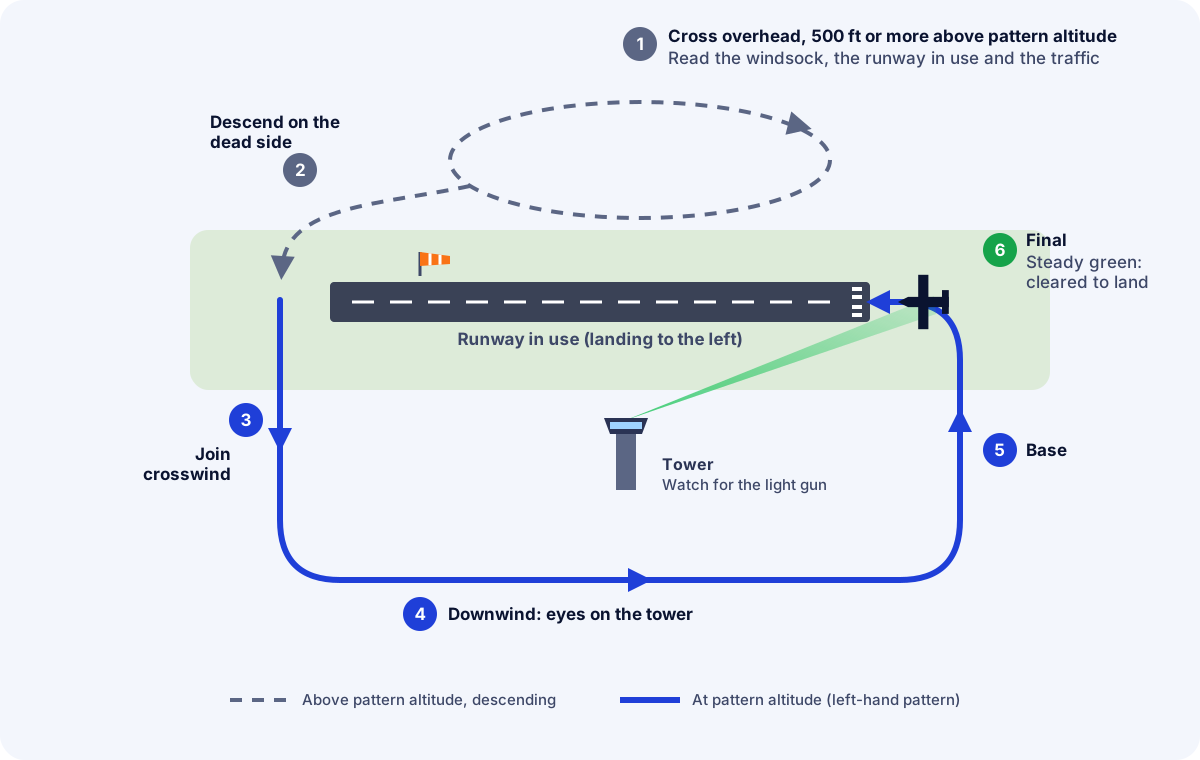
Once you're in the pattern, your job is simple and hard at the same time: fly a normal, predictable pattern and keep looking at the tower. The AIM's own list of the light gun's weaknesses starts with this one: the pilot may not be looking at the tower when the signal comes.
A first solo, a dead radio and a green light at Herzliya
Herzliya (LLHZ) is one of Israel's busiest general aviation airfields, just north of Tel Aviv, where flight schools fly circuits all day. Its circuit altitude is 800 feet, and its published lost-comms join is precise. The pilot tries to phone the tower on one of its two published numbers, flies in on the published entry route at 1,200 feet with the landing lights on, passes over the tower, joins the circuit for the runway in use while descending to 800 feet, and lands after a green light. A note adds that the tower will keep transmitting instructions, in case only the transmitter has failed.
That's the procedure Allon flew. After one of his first solo flights, returning to the field, he lost communication on base. He flew Herzliya's lost-comms procedure 400 feet above the circuit, the same 1,200 feet the procedure publishes for joining. He entered at the beginning of the crosswind leg and flew the circuit watching the tower. On final, the light came: steady green, cleared to land.
While he was in the circuit, he saw another airplane go around. Nobody on the ground told him why, but the timing said it all: the tower had apparently sent it around to clear the airfield for the student with no radio.
The airplane that went around wasn't in trouble. It was making room for me.
There are three lessons in that landing. The procedure works, if you've read it before you need it. ATC adapts around you: other traffic waits or goes around so the silent airplane can land. And it happens when you least expect it: on base, at the end of a routine flight, to a pilot with only a few hours of solo time.
Light gun signals, explained
The light gun, a signal lamp, is a narrow, powerful spotlight with a sight and a trigger. The controller aims it at your airplane and shows a colour: steady or flashing, green, red or white. It's old technology, and control towers still keep one, because it works with no radio at all.
Here's what each signal means in the United States, from 14 CFR 91.125 and AIM 4-3-13.
FAA light gun signals (14 CFR 91.125)
Steady green
- In the air
- Cleared to land
- On the ground
- Cleared for takeoff
Flashing green
- In the air
- Return for landing, then wait for a steady green
- On the ground
- Cleared to taxi
Steady red
- In the air
- Give way to other aircraft and continue circling
- On the ground
- Stop
Flashing red
- In the air
- Airport unsafe, do not land
- On the ground
- Taxi clear of the runway in use
Flashing white
- In the air
- Not used
- On the ground
- Return to starting point on the airport
Alternating red and green
- In the air
- Exercise extreme caution
- On the ground
- Exercise extreme caution
ICAO's table, used across Europe (as SERA Appendix 1), Israel and most of the world, is almost the same. Three differences matter:
ICAO and EASA light signals (Annex 2 and SERA Appendix 1)
Steady green
- In the air
- Cleared to land
- On the ground
- Cleared for takeoff
Series of green flashes
- In the air
- Return for landing
- On the ground
- Cleared to taxi
Steady red
- In the air
- Give way to other aircraft and continue circling
- On the ground
- Stop
Series of red flashes
- In the air
- Aerodrome unsafe, do not land
- On the ground
- Taxi clear of landing area in use
Series of white flashes
- In the air
- Land at this aerodrome and proceed to apron
- On the ground
- Return to starting point on the aerodrome
Red flare (pyrotechnic)
- In the air
- Notwithstanding any previous instructions, do not land for the time being
- On the ground
- Not used
- Flashing white in the air means nothing in the US, but under ICAO it means "land at this aerodrome and proceed to apron." You might see it if you're diverting to a field you didn't plan on.
- The red flare exists only in the ICAO table: whatever you were told before, don't land yet.
- Alternating red and green ("exercise extreme caution") exists only in the FAA table.
Other countries add their own twists. Australia's ERSA says a steady green means authorised to land "if pilot satisfied no collision risk exists." Canada's red pyrotechnic is used only at military towers.
How to acknowledge a light signal
The tower needs to know you saw it.
- By day, in the air: rock your wings. ICAO adds: except on the base and final legs, when wing-rocking is a bad idea close to the ground.
- At night, in the air: flash the landing light or the navigation lights. ICAO says twice; Canada says a single flash of the landing light; the FAA says to blink the landing or navigation lights.
- On the ground: move the ailerons or rudder.
The light gun has real limits. The AIM notes it can only give "approval or disapproval of a pilot's anticipated actions." In 2016, NATCA, the US controllers' union, reported that controllers at 14 facilities had filed safety reports saying their light guns were hard to see. One said no aircraft could see them in daylight. Many units dated from the 1950s, and the FAA updated its specifications in 2015 and made new units available. If you can't see a light, don't assume you've been cleared. Keep flying the pattern and keep looking.
When it really happened: lost comms in the record
Investigation reports are full of radio failures. Most end quietly. The interesting ones show what works, what doesn't, and what goes wrong next.
Light aircraft: the phone and the light gun
Grand Junction, Colorado, November 2002. A Piper Arrow's alternator failed, and all electrical power was gone about 35 miles out. According to the NTSB, "the pilot used his cell phone to call GJT Tower and he was given clearance to land." On rollout, the left main gear collapsed.
Myrtle Beach, South Carolina, March 2016. A Cessna 210 lost all electrical power after takeoff; the NTSB traced it to a corroded alternator wire. The NTSB report says: "The adult passenger then called the control tower via a cell phone and was cleared to land." The gear wouldn't extend fully, and it collapsed after touchdown. Nobody was hurt.
Dallas Love Field, October 2015. A Piper Lance had a total electrical failure after takeoff at night, and its transponder return vanished from the controllers' screens. According to NATCA's account of the event, the pilot dialled 911. The dispatcher alerted the tower, and on the pilot's second call he was patched through. One controller talked to him by phone while a second took every other frequency and asked a waiting Boeing 757 crew, a King Air and an airport vehicle to check visually whether his gear was down. He landed with the engine off and stopped within the first 1,700 feet of the runway.
Opa-Locka, Florida, November 2017. At night, on an instrument approach, a Cessna 172RG lost electrical power and its radios at about 500 feet. The safety pilot squawked 7600, and "after receiving a green light gun signal from the tower, the pilot continued the approach," the NTSB wrote. The right main gear collapsed; the gear warning horn and low-voltage light had both gone dark with the electrics.
Billings, Montana, March 2024. A Beech King Air B200 had a total electrical failure shortly after departure. The tower "cleared the pilot to land by using a green light gun signal." The NTSB found the generators had never come online after an improper engine start, and the battery lasted 18 minutes. The manual gear extension wasn't complete, and the gear collapsed on landing.
Bern, Switzerland, July 2025. Swiss media reported that a propeller aircraft with serious electrical problems lost radio contact and disappeared from radar. Military radar found it again. The tower cleared the airspace, sent blind calls on every frequency and guided the pilot in with a hand-held light gun. The pilot recognised the signals and landed safely. This one comes from press reports citing unnamed sources, not an official investigation.
Four NTSB reports, four total electrical failures, four collapsed landing gears.
Look at the pattern in those reports. The radio was rarely the real danger. An electrical failure takes the landing gear lights, the gear motor or the warning horn with it, and the pilot lands not knowing whether the gear is down and locked. In Dallas, the controllers on the phone could ask other crews to look. A light gun can't do that.
Airliners that went silent
Northwest 188, October 2009. An Airbus A320 from San Diego to Minneapolis was out of contact for, in the NTSB's words, "about 1 hour 17 minutes" at 37,000 feet. The first officer had probably never finished dialling in a new frequency, and both pilots were working on their laptops. They flew past Minneapolis and finally called from over Eau Claire, Wisconsin: "roger, we got distracted and we've overflown Minneapolis." Controllers told the NTSB that silent airliners happen "as often as several times during an 8-hour shift."
Air Canada 795, November 2009. Two weeks later, an A320 from Toronto to Los Angeles was out of contact for 37 minutes. The crew had been getting static on 121.5 and had turned the volume down. Another aircraft relayed the call that finally got through.
Jet Airways 9W118, February 2017. A Boeing 777 from Mumbai to London lost contact at a handoff over central Europe. According to NATO, it flew on into Germany for almost an hour without talking to ATC, and two German Eurofighters were launched to intercept it. Press reports put the silence at closer to half an hour. Either way, fighters were alongside a widebody full of passengers because of a radio frequency.
The UK's sonic booms. In January 2021 and March 2023, RAF Typhoons were authorised to fly supersonic over England to reach civil aircraft that had stopped talking to ATC. Both aircraft were escorted to Stansted, and the booms were heard across several counties.
77 minutes without a word, and the radios worked fine the whole time.
When silence turns deadly
Gol 1907, Brazil, September 2006. An Embraer Legacy business jet and a Gol Boeing 737 collided at 37,000 feet over the Amazon, killing all 154 people on the 737. The NTSB's factual report records that "between 3:51 pm and 4:26 pm, there were no attempts to establish radio communications from either the crew of N600XL or ATC," and the Legacy's transponder signal stopped being received at 4:02. Neither airplane's collision-avoidance system gave an alert. Later, the Legacy crew made a dozen calls, and heard a frequency change without all its digits. A lost-comms situation that nobody treated as one ended in the worst accident in Brazilian aviation at the time.
How often does this happen?
- Over Europe: NATO's air command counted more than 900 lost-comms reports in 2018. Fighters launched for almost one in ten. More than 75% were down to human error, 15% technical. Loss of communication is the main reason NATO scrambles its alert fighters, and EUROCONTROL says 90% of interceptions in Europe are attributed to it.
- Earlier European data: a study EUROCONTROL cited found that 40% of loss-of-communication events became prolonged losses. Among equipment causes, "sleeping" receivers that stopped receiving without warning came first, at 53%.
- In the US: NORAD said in 2012 that general aviation aircraft made up the majority of its more than 1,500 intercepts since 2001. AOPA's intercept procedures card lists the number one reason as "entering restricted airspace and not talking to ATC."
In 2018 NATO logged more than 900 lost-comms reports over Europe. Fighters launched for almost one in ten.
When the transponder dies too
Every one of the procedures above starts with the same step: squawk 7600. That step assumes something no checklist card says out loud: that your transponder still has power.
In most light aircraft, the transponder and the radios share an electrical system. When that system fails, they fail together, and so does ADS-B Out. There is nothing left to squawk. To the controller you're at best an unlabeled blip on primary radar, and down low, outside primary radar coverage, you may not be there at all. That's what happened in Dallas: the Lance's return simply vanished.
That's where the phone comes in. We wrote about the transponder problem in our article on how pilots really use checklists. Here, let's look at whether the phone is allowed, and whether it works.
Can you call ATC on your phone?
The record says yes, it works. Grand Junction, Myrtle Beach and Dallas all ended with a phone call and a clearance. A 2020 NASA ASRS bulletin describes a pilot with a total electrical failure in cloud who called Flight Service on a cellphone and asked them to relay to approach control.
The rules are catching up, unevenly:
- The EU says yes. SERA.14083, since May 2025, tells pilots to try "all available means," naming mobile phones. And a VFR flight must report its arrival "by the most expeditious means," which on the ground is a phone call.
- Israel says yes. The national procedure lists the mobile phone among the ways to re-establish contact, and Herzliya, Ben Gurion and Haifa publish tower numbers in their lost-comms procedures.
- The UK tells you to report your arrival "as soon as possible," and its AIP gives a telephone line for the London Distress and Diversion cell (for approved aircraft installations).
- The FAA hasn't caught up. AIM 4-2-13 tells you to "call the tower by telephone" to request a departure without a radio, but says nothing about calling from the air. The FCC's rule 47 CFR 22.925 says cellular phones "must not be operated" while an aircraft is airborne. AOPA put it plainly in 2022: FAA rules and policies "have not been updated for the use of cellphones," and advised pilots to record tower numbers and rely on the pilot in command's emergency authority (14 CFR 91.3). In 2013, a proposal to publish ATC phone numbers in the FAA's Airport/Facility Directory (now the Chart Supplement) noted they could enable NORDO communication "in certain situations."
Use the phone the way every procedure uses everything else: aviate, navigate, communicate. Fly the airplane first and keep flying the published procedure. Call when the airplane is stable and you can do it safely. Coverage is usually better low and near towns. And remember the Dallas lesson: a call to emergency services works, but a call straight to the tower is faster.
The hard part is the number. It's printed somewhere: in the Chart Supplement, in your country's AIP, on a page you photographed before the flight. None of that helps at 1,200 feet with a dead panel, both hands busy and a student's heart rate.
ZuluCheck: the comms backup in your pocket
That's exactly the problem ZuluCheck was built to solve.

- One tap to call the tower. The frequency bar at the bottom of every checklist screen shows your local frequencies and 121.5. Tap it, and the radio-failure sheet opens with the phone numbers you need: the nearest aerodrome's tower or operator, a backup ATC unit such as approach or the area control centre, and the rescue coordination centre. Each is one big button that dials with a single tap.
- The right numbers for where you are. ZuluCheck picks the nearest aerodrome from your location, or uses your home field. Where an AIP publishes dedicated radio-failure lines, like Herzliya tower's two numbers, ZuluCheck marks them in red.
- Built in, offline, sourced. More than 5,000 aerodromes so far: every public-use airport in the United States, plus the UK, France and Israel. The numbers are stored in the app, so the list appears with no data signal, along with its source and date.
- Your headset, your phone. If your headset pairs with your phone over Bluetooth, as many current aviation headsets do, the call comes through your ear cups, over the engine. Most Bluetooth headsets run on their own batteries, so they keep working when the panel doesn't.
- Every emergency checklist, one tap away. A red button on every screen opens the emergency procedures, transcribed from the aircraft's own POH, with memory items first and best glide in view. Bigger type, one item at a time, and nothing to flip through. Emergency checklists are free for everyone.
A laminated card can't dial a phone. Neither, as far as we know, can any other checklist app.
As a parent, I wouldn't want my kids to fly without it.
ZuluCheck is free forever for two aircraft, with every feature included. ZuluCheck Pro adds unlimited aircraft for clubs, rental pilots and instructors.


ZuluCheck is for reference only and is not a substitute for the aircraft's approved flight manual or the procedures published in your country's AIP. Phone numbers can change: check them before flight, and always fly the airplane first.
Frequently asked questions
What does squawk 7600 mean?
Transponder code 7600 tells air traffic control that the aircraft has lost two-way radio communication. It is used worldwide. It only works if the transponder has power and the aircraft is within radar coverage, so after an electrical failure it may not reach anyone.
What should a VFR pilot do if the radio fails?
Troubleshoot first (volume, frequency, audio panel, headset, circuit breakers), then squawk 7600, stay in visual conditions and land at the nearest suitable aerodrome. At a towered field, follow its published lost-comms procedure, watch the tower for light signals and land only on a steady green. After landing, report your arrival to ATC by phone.
Can you land at a towered airport without a radio?
Yes. In the US, 14 CFR 91.129(d) allows it if the weather is at or above basic VFR minimums, you keep visual contact with the tower and you receive a clearance to land, which can be a steady green light signal. Other countries have similar rules.
What do the light gun signals mean?
In the air: steady green means cleared to land; flashing green means return for landing; steady red means give way to other aircraft and continue circling; flashing red means the airport is unsafe, do not land. On the ground: steady green means cleared for takeoff, flashing green cleared to taxi, steady red stop, flashing red taxi clear of the runway, and flashing white return to your starting point.
How do you acknowledge a light gun signal?
In flight by day, rock your wings (ICAO says not on base or final). At night, flash your landing lights or navigation lights. On the ground, move the ailerons or rudder.
What is the difference between FAA and ICAO light signals?
They're nearly identical. ICAO gives flashing white a meaning in flight ("land at this aerodrome and proceed to apron") and adds a red flare meaning "do not land for the time being." The FAA adds alternating red and green, meaning "exercise extreme caution."
Can I call ATC on my cell phone if my radio fails?
In the EU, yes: since May 2025, SERA.14083 tells pilots to try all available means, including mobile phones. Israel's procedures also name the mobile phone. In the US, the FAA's rules don't mention phones, and an FCC rule bars airborne cellphone use, but pilots have repeatedly used phones to get landing clearances in emergencies, and the pilot in command may deviate from rules to meet an emergency. Fly the airplane first and call only when it's safe.
What is PLOC or COMLOSS?
Prolonged loss of communication (PLOC), or COMLOSS, is when an aircraft stays out of contact with ATC for an extended time. In Europe it is the main reason air forces scramble interceptors. Most cases are human error, such as a wrong frequency or a radio turned down.
What is the lost comms procedure at Herzliya (LLHZ)?
Israel's domestic AIP tells pilots to try phoning the tower, join on the published entry routes at 1,200 feet with landing lights on, pass over the tower, join the circuit for the runway in use while descending to the 800-foot circuit altitude, and land after a green light. Always check the current AIP before flight.
Sources
- FAA Aeronautical Information Manual: 4-2-13, communications with the tower when the radio is inoperative (opens in a new tab), 4-3-13, traffic control light signals (opens in a new tab) and 6-4, two-way radio communications failure (opens in a new tab)
- 14 CFR 91.125 (opens in a new tab), 91.129 (opens in a new tab), 91.185 (opens in a new tab) and 47 CFR 22.925 (opens in a new tab)
- FAA JO 7110.65, chapter 3 section 2: ATC light signals (opens in a new tab)
- FAA Airplane Flying Handbook, chapter 8: airport traffic patterns (opens in a new tab) and AC 90-66C (opens in a new tab)
- Commission Implementing Regulation (EU) 2024/404, amending SERA (opens in a new tab) and SERA Appendix 1, light signals (opens in a new tab)
- UK AIP ENR 1.1 (opens in a new tab), UK CAA Skyway Code (CAP 1535) (opens in a new tab) and CAA: radiotelephony for general aviation pilots (opens in a new tab)
- Israel AIP (international) (opens in a new tab) and Israel domestic AIP, Hebrew (Civil Aviation Authority) (opens in a new tab)
- Transport Canada AIM, RAC (opens in a new tab) and Airservices Australia ERSA, emergency procedures (opens in a new tab)
- IFATCA WP-2025-96, ICAO Annex 2 radio failure provisions (opens in a new tab)
- NTSB reports: DEN03LA014, Grand Junction (opens in a new tab), ERA16LA135, Myrtle Beach (opens in a new tab), ANC18LA009, Opa-Locka (opens in a new tab), WPR24LA109, Billings (opens in a new tab), DCA10IA001, Northwest 188 (opens in a new tab), OPS10IA002, Air Canada 795 (opens in a new tab) and DCA06RA076A, Gol 1907 (copy) (opens in a new tab)
- NATCA: Dallas Love Field controllers, 2016 (opens in a new tab) and NATCA: voluntary reporting and light guns, 2016 (opens in a new tab)
- blue News: Bern tower uses a light gun, 2025 (opens in a new tab)
- NASA ASRS Directline 6: lost com (opens in a new tab) and CALLBACK 481 (opens in a new tab)
- NATO Allied Air Command and EUROCONTROL on COMLOSS (2019, archived) (opens in a new tab), EUROCONTROL: tackling the risks of COMLOSS (opens in a new tab) and EUROCONTROL action plan for air-ground communications safety (opens in a new tab)
- The Aviationist: Typhoons escort a silent Boeing 777 over Germany (2017) (opens in a new tab), Forces News: RAF sonic boom (2021) (opens in a new tab) and LBC: sonic boom over England (2023) (opens in a new tab)
- NORAD on general aviation intercepts (2012, archived) (opens in a new tab) and AOPA NORAD/FAA intercept procedures card (opens in a new tab)
- AOPA: training and safety tip, lost com (2022) (opens in a new tab) and FAA Aeronautical Charting Forum RD 13-01-267 (opens in a new tab)